
Delphi Studies
A Delphi study gives a research team a structured way to build consensus among experts when a question cannot be settled by trial data alone, or when the trial evidence that does exist is thin, mixed, or open to genuine clinical judgment. Different medical disciplines make regular use of the method for that reason: quite often when current guidelines are believed to be insufficient or non-existent.
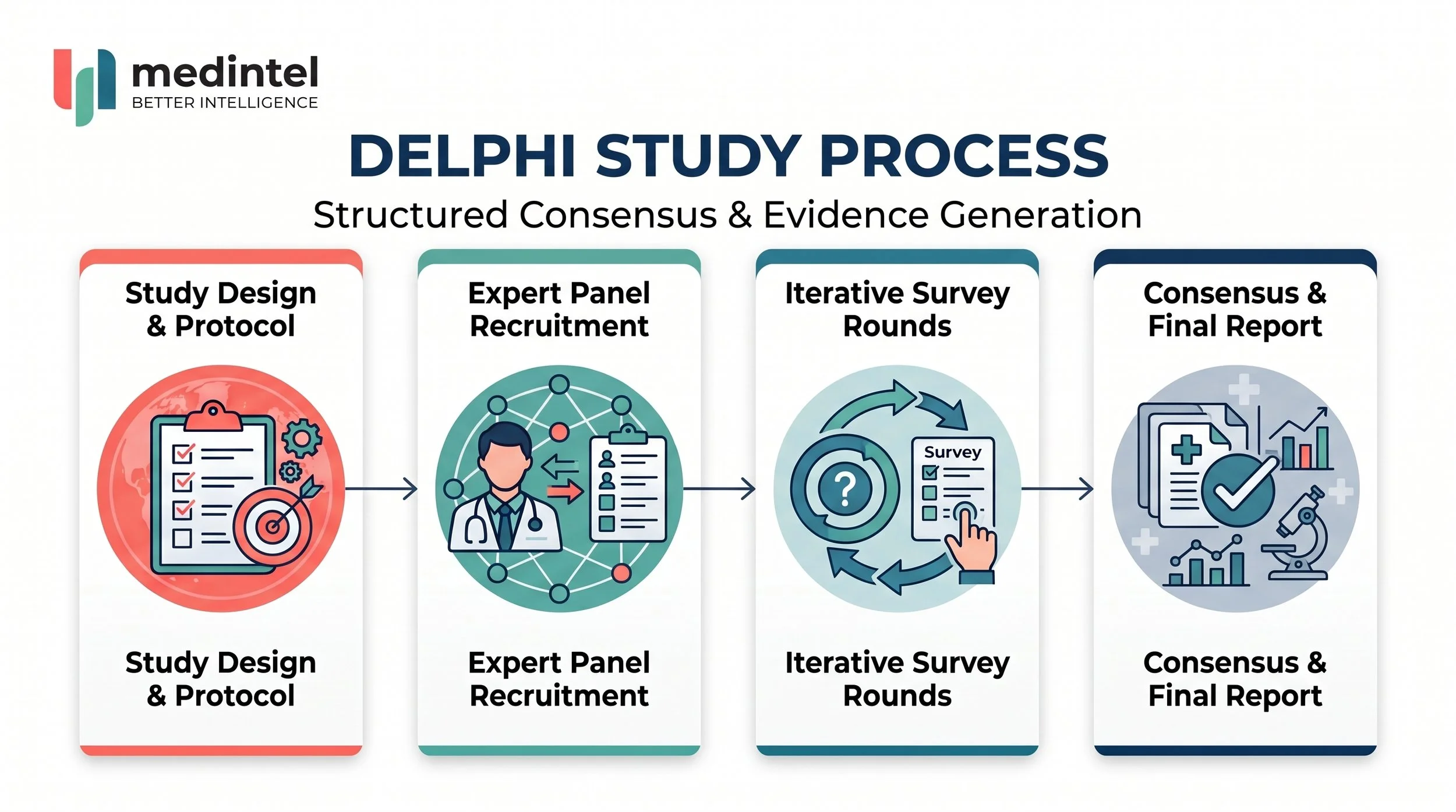
Example of a medintel Published Delphi Study
Journal of Endovascular Therapy, 2026.
medintel provided the study design, data collection, analysis and support to the expert panel in drafting this manuscript.
Types of Delphi Studies and Why Researchers Choose Them
Choosing between Delphi Approaches
The choice between them turns less on tradition than on what the project needs: a first round that defines the issue or one built from existing evidence.
Whichever variant fits, the same reporting habit applies across all of them. State the round count, the panel composition and size, the consensus definition, and what was modified and why, so a reader can judge the result on the method actually used rather than on the label attached to it.
Classical (conventional) Delphi
Methodology at a glance
First round: open. Panellists raise and frame issues themselves.
Rounds: three is a common working minimum in practice.
Anonymity: full. No panellist knows another panellist’s identity or responses.
Feedback: statistical summary (median, interquartile range) returned each round.
When to use it
Use classical Delphi when the research question is still open enough that panellists need a first round to define the issues themselves, and the timeline allows three or more rounds of anonymous iteration with controlled feedback.
A classical Delphi panel answers several rounds of questionnaires. Typically, three has become a common working minimum in applied research (Nasa, Jain, & Juneja, 2021).
The panel starts with a first round in which panellists raise issues in their own words, rather than respond to statements the research team has already written. After each round, the team returns a statistical summary of the group's answers, typically the median and interquartile range, so panellists can see where they sit relative to the group before answering again. No panellist knows who said what.
This approach stops a senior voice on the panel from carrying more weight than the data warrant, and it lets participants change position without doing so in front of colleagues.
We would recommend doing this approach by one-on-one interviews at international symposia.
Panel size is not fixed by the method itself. Published classical Delphi panels have ranged from a handful of specialists to several hundred respondents, though most published studies converge on a panel of somewhere between 12 and 30 experts. The right number is driven by how narrow the pool of required expertise is, rather than by a rule the technique imposes.
Modified Delphi
Methodology at a glance
First round: structured. Built from a literature review, prior interviews, or existing draft statements.
Rounds: typically two or more.
Anonymity: full, as in the classical design.
Feedback: statistical summary returned each round.
Item handling: items can be dropped once they reach consensus, or once they show no sign of reaching it.
Consensus threshold: fixed and stated in advance; reported cutoffs across published studies typically 75% agreement for consensus.
Panel size: no fixed rule; recent vascular and interventional examples range from a dozen specialists to well over a hundred (de Donato et al., 2026; Jaffer et al., 2021; Tinelli et al., 2024).
When to use it
Use a modified Delphi when a body of literature, prior interviews, or draft guidance already exists to build a questionnaire for round one, and the goal is to test and refine those statements rather than generate them from nothing.
A modified Delphi keeps the anonymity and controlled feedback of the classical design but replaces the open first round with a structured questionnaire built beforehand, usually from a literature review and prior qualitative interviews. Panellists rate or rank items instead of generating them from a blank page, which removes a round and gives them something concrete to react to.
That efficiency is why the modified design turns up most often in work that produces clinical guidelines and consensus statements, where a research team has usually already gathered enough evidence or opinion to draft starting statements.
Three recent Delphi studies from vascular and interventional practice show how differently that modification can be applied. de Donato et al. (2026) replaced the open first round with individual semi-structured interviews, then built 57 consensus statements from the interview transcripts for a 12-member European panel of vascular surgeons, interventional radiologists, a transplant surgeon, and a nephrologist to rate over two further rounds. Jaffer et al. (2021) built their round one questionnaire from a systematic literature review and an open call for priority topics, then ran two rounds with a 13-member UK multidisciplinary panel, delivered as online questionnaires completed around meetings held in person rather than by mail alone. Tinelli et al. (2024) took a third approach again: a core team of study investigators and a biostatistician wrote the initial statements directly, without an open first round or preparatory interviews, then tested them over three rounds with an international panel of 174 experts using a fully online platform.
Real-time Delphi
Methodology at a glance
Rounds: none. A single questionnaire stays open and live.
Anonymity: full.
Feedback: continuous; group statistics update as each panellist answers.
Revision: panellists can change an answer at any point against the current group picture.
Typical timeframe: days rather than months.
When to use it
Use real-time Delphi when the timeline is short, the questions are defined well enough not to need an open first round, and continuous rather than staged feedback suits the topic.
Real-time Delphi drops the round structure altogether. Instead of waiting for every panellist to respond before compiling and returning a summary, the system updates group statistics continuously and shows them to each panellist as soon as the questionnaire is opened, so a panellist can revise an answer at any point against a live picture of the group. Online software such as Welphi (Welphi.com) can be used.
Gordon and Pease (2006) built the approach specifically to address the time cost of the classical design, and the appeal is speed. A process that would take months under a classical or modified design can run in days, with some systems flagging an individual's answer automatically when it sits well outside the group range and prompting that panellist to comment.
What real-time Delphi gives up is the discrete pause between rounds that lets a classical or modified panel sit with the group's prior answers before responding again. That makes it a better fit for fast prioritization or forecasting exercises than for questions that benefit from slower, more deliberate reflection between rounds.
Policy Delphi – Multiple Stakeholders
Methodology at a glance
Panel: informed advocates for different positions, not a single pool of similarly qualified experts.
Anonymity: relaxed. Panellists may be identified by role or affiliation.
Feedback: the range of views and the reasoning behind them, not a median score.
Output: a structured account of disagreement rather than a converged consensus.
When to use it
Use policy Delphi when the research question involves genuinely competing interests or values, and the useful output is a structured account of where and why experts disagree rather than a single group position.
Policy Delphi is built for a different job than the other three. It does not aim for a single converged answer. It aims to surface the strongest form of each opposing position on a genuinely contested question, then report where and why panellists disagree.
That changes panel recruitment. Instead of one pool of similarly qualified experts, a policy Delphi deliberately includes informed advocates for different positions, sometimes alongside a referee role to keep the debate structured. de Loë, Melnychuk, Murray, and Plummer (2016) reviewed 63 published policy Delphi studies and found deliberately heterogeneous panels to be standard practice for the variant. Feedback between rounds summarizes the range of views and the reasoning behind them rather than a median score, and reporting formats vary widely, from narrative accounts through descriptive statistics to graphical displays (de Loë et al., 2016).
For a question such as how a new reimbursement pathway should treat a borderline technology, where clinicians, payers, and patient groups have legitimate and different stakes, collapsing the panel's views into a single consensus figure would hide the disagreement that actually matters to the people making the decision. Policy Delphi reports the disagreement instead of averaging over it.
It is also less prescriptive about anonymity than the other three variants: panellists may be identified by role or affiliation, since knowing that a view comes from a payer rather than a treating clinician is often part of what makes the disagreement legible.
Best practice for delivering Delphi studies
1. Define the problem before writing questions. Set out why a Delphi is the right tool for this specific gap, whether that is evidence that is absent, contradictory, or not answerable by trial data, and document the literature search (databases, keywords, date range) that informed round one.
2. Select the panel on stated criteria. Fix the expertise required, the degree of homogeneity wanted across panellists, and the target size before recruiting, rather than justifying the choice after the fact.
3. Keep panellists anonymous from one another. Anonymity is what lets a panellist revise a position without doing so in front of colleagues, and what keeps a senior voice from carrying more weight than the data warrant.
4. Return controlled feedback in an easily read format. A statistical summary, such as the median, the interquartile range, or a simple chart, lets each panellist see where they sit relative to the group before the next round.
5. Plan for genuine iteration. Two rounds are rarely enough to show whether opinion is actually settling. Build in enough rounds to test whether answers stay stable once feedback has been seen.
6. Fix the consensus definition before round one. State the percentage agreement cutoff, or other statistical measure, in the protocol, not after the data are in.
7. Check stability, not just consensus. A group can reach a consensus percentage that is still moving round to round, and a group's answers can stabilize without ever reaching the consensus threshold. A complete report covers both stability and consensus.
Why choose medintel for Delphi?
Specialist medical analysts and writers to support KOLs at at every stage
Deep Therapeutic Area Knowledge
First-hand experience across cardiovascular, vascular intervention, surgical, and diagnostic devices — ensuring the clinical context and nuances behind every Delphi statement are accurately captured.
Support for KOLs in Manuscript Drafting
Writing and data support for KOLs every step of the way, ensuring the correct analysis and write up is delivered on time.
Study Design Aligned With Publication Goals
Team of data analysts ready to design publishable outcomes: high-quality data collection and analysis delivered to the spec of the requested high-impact journal.
Experienced Project Management
End-to-end management of iterative rounds, anonymous feedback loops, and response stability tracking in full alignment with published methodological standards.
-
"We'd had two previous attempts at PMCF surveys with larger CROs that came back with Notified Body queries. medintel redesigned the protocol from scratch and the report sailed through our BSI audit first time. The team clearly understand what NBs actually want to see — not just what the MDCG guidance says."
Regulatory Affairs Manager, Class IIb implantable device manufacturer (Germany)
-
"Our EU MDR transition timeline was under serious pressure. MedIntel turned around a Level 4 PMCF survey across five EU countries in fourteen weeks — verified HCPs, clean data, compliant report. That's genuinely faster than anything we'd been quoted elsewhere, without any compromise on quality."
VP Clinical & Medical Affairs, US-headquartered surgical robotics company (EU MDR transition)
-
"medintel handled our PMCF survey across interventional radiologists in the US and EU simultaneously. The cross-market analysis they produced — not just the regulatory deliverable but the commercial insight layered on top — gave our clinical and marketing teams data they could both use. That dual value is unusual."
Clinical Evidence Manager, vascular intervention company
Let’s Work Together
If you're interested in a regulatory matter, complete the form with a few details about your project. We'll review your message and get back to you within 48 hours.